Tripod Joint Drive Shaft Industry Analysis
In modern automotive drivetrain systems, the Tripod Joint Drive Shaft plays a crucial role. With the increasing prevalence of front-wheel-drive vehicles and electric vehicles, this component's impact on overall vehicle performance, comfort, and durability is becoming increasingly apparent. This article will provide a comprehensive analysis of the core value of the Tripod Joint Drive Shaft from multiple dimensions, including structure, working principle, applications, and industry trends.
What is a Tripod Joint Drive Shaft?
A Tripod Joint Drive Shaft is a key component for power transmission, primarily connecting the transmission to the wheels. Its core feature is the use of a "tripod joint" on the inner side, enabling axial extension and retraction during power transmission.
This design allows it not only to stably transmit torque but also to adapt to length changes caused by suspension movement during vehicle operation, thus ensuring smooth vehicle operation.
Core Structural Components Analysis
A standard Tripod Joint Drive Shaft typically consists of the following parts:
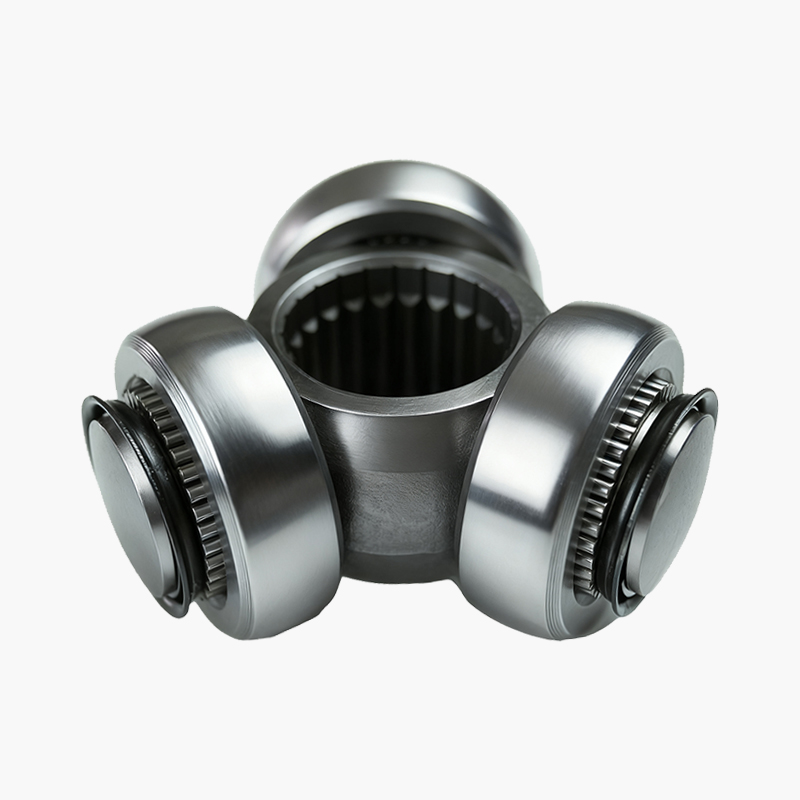
- Tripod Spider: Responsible for bearing torque and connecting rolling components
- Needle Bearings: Reduce friction and improve smooth operation
- Tulip Housing: Provides axial sliding space
- Drive Shaft: Connects the inner and outer constant velocity universal joints
- Boot & Grease: Protect the internal structure and extend service life
These components work together to ensure the stable operation of the drive shaft under complex conditions.
Working Principle and Technical Advantages
The biggest advantage of the Tripod Joint lies in its axial compensation capability.
During vehicle operation:
- The vertical movement of the suspension changes the length of the drive shaft
- The Tripod Spider slides freely within its tracks, achieving length adjustment
- Simultaneously, it maintains continuous power output
Compared to traditional universal joints, this structure performs more stably in reducing vibration (NVH) and improving comfort.
Differences between Tripod Joints and Traditional CV Joints
In practical applications, Tripod Joints are typically used in conjunction with outer CV joints:
- Tripod Joint (Inner CV Joint): Responsible for extension and cushioning
- CV Joint (Outer CV Joint): Responsible for large-angle steering
This combination of "inner tripod + outer CV joint" has become the mainstream solution in the industry and is widely used in various vehicle models.
Main Application Areas
Tripod Joint Drive Shafts are widely used in:
- Front-wheel drive vehicles (FWD)
- Four-wheel drive and SUV vehicles
- Light commercial vehicles
- Emergency electric vehicles (EVs)
Especially in the electric vehicle sector, the more direct torque output of the motor places higher demands on the durability and stability of the driveshaft.
Product Performance Advantages
Choosing a high-quality Tripod Joint Drive Shaft typically offers the following advantages:
- Excellent axial extension performance, adapting to complex road conditions
- Low vibration and low noise (good NVH performance)
- Compact structure, contributing to lightweight design
- Suitable for mass production, with reasonable cost control
- These advantages make it one of the key solutions in automotive drivetrain systems.
- Common Faults and Maintenance Recommendations
During long-term use, the Tripod Joint Drive Shaft may experience the following issues:
- Dust boot rupture leading to grease loss
- Wearing needle roller bearings is causing abnormal noise
- Increased slide clearance affects power transmission
Maintenance Recommendations:
- Regularly check the dust boot seal
- Promptly detect any vibration or abnormal response
- Use high-quality grease and seals
- Proper maintenance can significantly extend product lifespan
- Industry Development Trends
With the development of automotive technology, the Tripod Joint Drive Shaft is being upgraded in the following directions:
- Using high-strength materials to improve durability
- Low-friction design to reduce energy consumption
- Lightweight structure optimization to improve fuel efficiency
- Adapting to the high torque demands of electric vehicles
These trends are driving continuous progress in the entire drivetrain industry.
The Tripod Joint Drive Shaft is not only a key component of the automotive drivetrain but also a crucial factor affecting overall vehicle performance. From structural design to material processing, every detail directly relates to the product's reliability and lifespan.

 English
 русский
 Español
 Português
 عربى
عربى