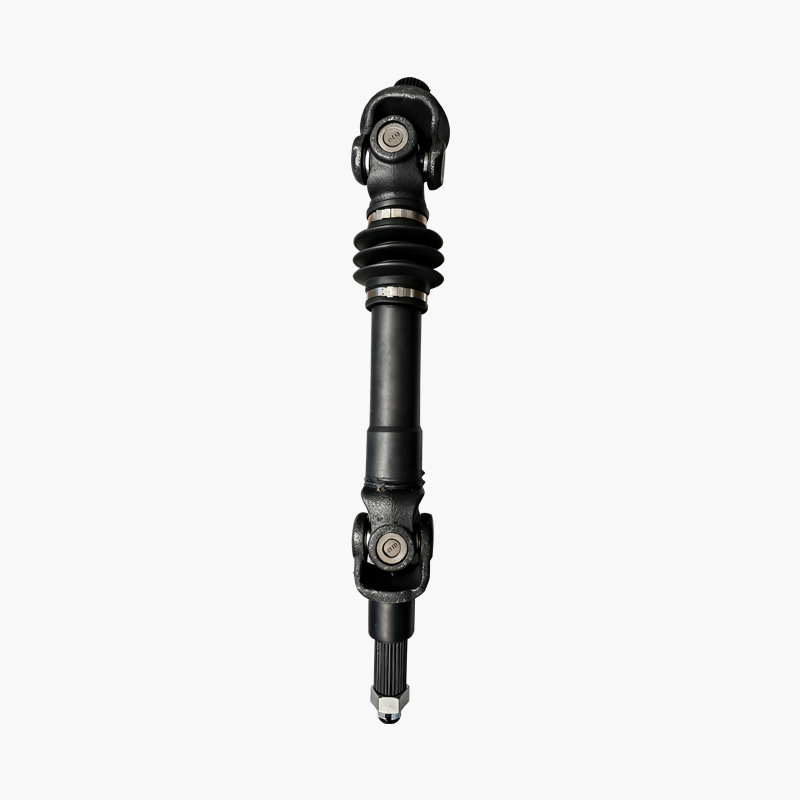
Propeller Shaft vs. Intermediate Shaft Industry knowledge expansion
1. Definition and Function
The Propeller Shaft is a key component used to transmit power from the transmission to the drive axle (differential), widely used in rear-wheel drive (RWD), four-wheel drive (4WD/AWD) vehicles, and construction machinery.
Its core functions are:
- Transmitting torque and rotational power
- Compensating for changes in the distance between the transmission and the drive axle
- Accommodating angular deviations that occur during vehicle movement
The Intermediate Shaft is a transition shaft located in the power transmission system, used to connect different components and achieve segmented power transmission.
Commonly found in:
- Four-wheel drive systems
- Inside the gearbox
- Steering systems (e.g., steering intermediate shafts)
2. Main structural components
Typical driveshafts include:
- Tube Shaft: Hollow steel tube, reducing weight while ensuring strength
- Universal Joint: Allows for angle changes, ensuring continuous power transmission.
- Slip Yoke: Compensates for axial length change.s
- Center Bearing: Used for segmented support of long shafts
3. Propeller Shaft Classification
By Structure
- Single Piece Shaft: Compact structure, suitable for short-wheelbase vehicles with a small transmission distance
- Two-Piece Shaft: Segmented design, equipped with a center bearing, suitable for medium and large vehicles with a long wheelbase
- Multi-Piece Shaft: Multi-segment combined structure, used in heavy machinery and large commercial vehicles with ultra-long transmission distance
By Application
- Passenger vehicle driveshafts: Lightweight and low-noise design, matching passenger car usage scenarios
- Commercial vehicle driveshafts: High-load and high-strength design, adapting to long-distance heavy-load transportation
- Construction machinery driveshafts: Ultra-high durability design, suitable for harsh working environments
- Agricultural machinery driveshafts: Wear-resistant and stable design, matching the farmland operation conditions
4. Intermediate Structural Characteristics and Main Applications of Shafts
Structural Characteristics:
- Typically short in size, with high overall rigidity to avoid bending deformation during transmission
- Equipped with a precision spline connection, ensuring a tight fit and stable torque transmission
- Can be equipped with a universal joint to realize small-angle deviation compensation and improve transmission adaptability
- High precision requirements for coaxiality, roundness, and dimensional accuracy to ensure efficient transmission
1) Automotive Powertrain Systems
In four-wheel drive systems, the intermediate shaft undertakes the key power distribution task, connecting:
- Transmission → Transfer Case
- Transfer Case → Front/Rear Drive Systems
2) Inside the Transmission
The intermediate shaft is a core internal part of the transmission, mainly used for:
- Stably transmitting gear rotational power between different gear sets
- Adjusting and changing the gear ratio to match different driving speed requirements
3) Steering Systems
The steering intermediate shaft connects the steering wheel and steering gear, undertaking the steering force transmission task, featuring:
- A telescopic structure to adapt to assembly errors and body movement
- Special energy-absorbing design to improve vehicle driving safety and reduce collision impact
5. Common Materials for Propeller Shafts
- Alloy steel (e.g., 40Cr, 42CrMo)
- High-strength steel
- Aluminum alloy (lightweight)
- Carbon fiber (high-end models)
- Materials and Processes of Intermediate Shafts
- Alloy steel (high strength and fatigue resistance)
- Surface treatment (carburizing, quenching)
- Precision grinding (improving fit accuracy)
6. Propeller Shaft Manufacturing Process
- Tube Forming (Cold Drawing/Hot Rolling)
- Welding (Friction Welding)
- Dynamic Balancing Correction (Key Process)
- Heat Treatment (Improving Fatigue Strength)
- Precision Machining (CNC)
7. Industry Technology Trends
Propeller Shaft:
- Lightweight (Aluminum Alloy, Carbon Fiber)
- High-Speed Stability (Higher Dynamic Balancing Requirements)
- NVH Optimization (Reducing Noise and Vibration)
- Electric Vehicle Adaptation (Higher Speed, Lower Noise)
Intermediate Shaft:
- Modular Design (Easy Assembly)
- High-Precision Machining (Adapting to Autonomous Driving)
- Enhanced Safety (Collision Energy Absorption Structure)
- Lightweight Material Application
8. Common Propeller Shaft Failures
- Vibration (Dynamic Balancing Failure)
- Abnormal Noise (Universal Joint Wear)
- Fracture (Fatigue Failure) Oil Leakage (Seal Failure)
9. Differences between Intermediate Shaft and Propeller Shaft
| project |
Propeller Shaft |
Intermediate Shaft |
| Length |
Longer |
shorter |
| Function |
Long-distance transmission |
Intermediate Transition Transmission |
| Structure |
With a universal joint and a support bearing |
Mostly rigid shafts |
| Application |
Chassis drive system |
Transmission, steering, and four-wheel drive system |

 English
 русский
 Español
 Português
 عربى
عربى