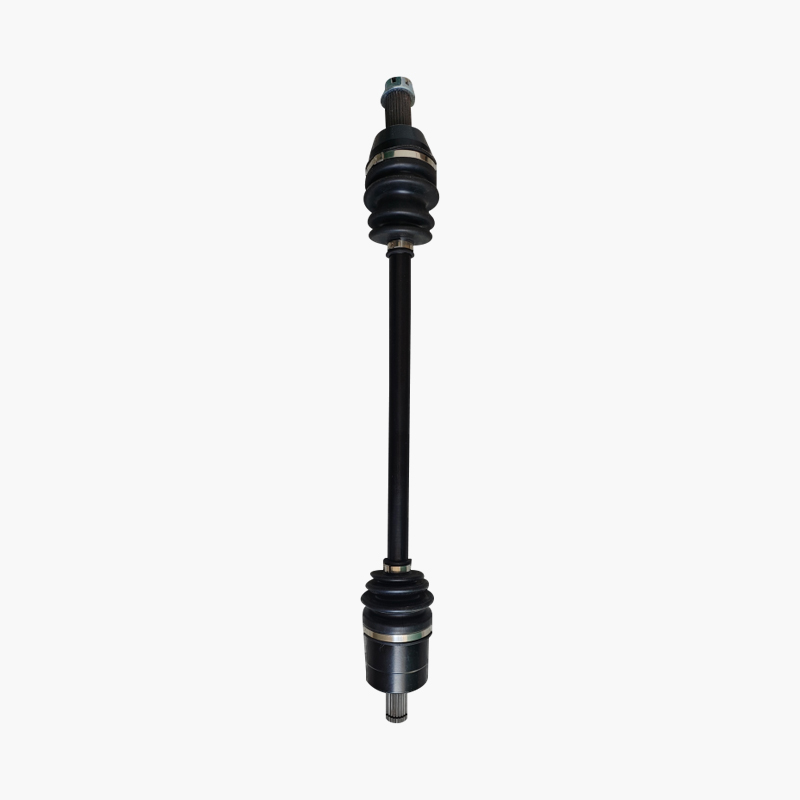
ATV C.V. Axle (Constant Velocity Axle): Components, Working Principle, and Selection Criteria1
What is an ATV C.V. Axle (Constant Velocity Axle)?
A C.V. Axle (Constant Velocity Axle) is a critical transmission component within an All-Terrain Vehicle's (ATV) drivetrain system. Its primary function is to reliably transmit power output from the engine to the wheels while simultaneously allowing the wheels to maintain a constant rotational speed—even as they articulate vertically (during suspension travel) or pivot during steering.
Compared to traditional universal joints, a C.V. Axle is capable of maintaining "constant velocity transmission" even when operating at large angles; this prevents power fluctuations and vibrations, thereby enhancing the vehicle's stability across complex terrain.
2. Structural Components of an ATV C.V. Axle
A typical ATV C.V. Axle primarily consists of the following components:
Inner CV Joint
Connects to the differential side; it allows for axial extension and compression to accommodate the suspension's compression and rebound movements.
Outer CV Joint
Connects to the wheel hub; it facilitates larger steering angles.
Shaft
The core steel rod is typically manufactured from high-strength alloy steel.
CV Boot
Made from rubber or TPU material, it serves to prevent dirt, sand, and moisture from entering the interior of the CV joints.
Grease
High-temperature lubricant used to minimise friction and wear.
3. Working Principle
The core principle behind a C.V. Axle lies in the rolling action of steel balls within the joint's internal tracks; this mechanism ensures that the input shaft and output shaft maintain identical angular velocities, even when the angle between them changes.
During ATV operation:
- Suspension vertical movement → The inner CV joint extends or compresses to compensate for changes in shaft length.
- Steering manoeuvres → The outer CV joint provides angular compensation.
- Power transmission → A smooth and continuous power output is maintained at all times.
This structural design is particularly well-suited for complex driving conditions involving rugged terrain, mud, sand, and mountainous landscapes.
4. Common Types of ATV C.V. Axles
Common classifications within the industry include:
① Traditional Rzeppa-type CV Axle
Features a mature, proven design and moderate cost; it serves as the standard equipment on the majority of ATVs.
② High-Angle CV Axle (Reinforced/Extended-Angle Type)
Designed for ATVs with modified, lifted suspensions, allowing them to accommodate significantly greater suspension travel.
③ Heavy-Duty CV Axle
Designed for high-load ATVs or competition models, enhancing torsional strength and impact resistance.
5. Materials and Manufacturing Processes
High-quality ATV CV axles typically utilise:
- 42CrMo / 40Cr Alloy Steel (for the axle shaft)
- Carburising and Quenching (to increase surface hardness)
- Precision Grinding (to ensure precise fitment of the CV cage)
- Heat Treatment Strengthening (to enhance fatigue resistance)
Manufacturing precision directly impacts service life and drivetrain stability.
6. Application Scenarios
ATV CV axles are widely used in:
- Agricultural Transport ATVs
- Mountain Off-road ATVs
- Recreational Beach ATVs
- Specialised Military and Police Vehicles (Light-duty)
- Racing and Modified ATVs
They are particularly critical in extreme environments involving mud, rocks, and steep inclines.
7. Common Failures and Issues
Common issues encountered in the industry include:
- CV Boot Rupture → Ingress of dirt and sand, leading to accelerated wear
- Abnormal Noise (Clicking) → Wear within the CV cage or insufficient lubrication
- Vibration → Axle imbalance or excessive internal clearance
- Grease Leakage → Seal failure
It is generally recommended to regularly inspect the condition of the dust boots, as this is key to extending the axle's service life. 8. Key Considerations for Selection and Procurement (From the Perspective of Trading Companies and Manufacturers)
When sourcing ATV C.V. Axles, the primary focus should be on the following factors:
- Compatible Vehicle Models (e.g., Polaris, Can-Am, Yamaha)
- Axle Length and Spline Specifications
- Maximum Articulation Angle Capability
- Compatibility with Lift Kits (Suspension Modification)
- Material Hardness and Heat Treatment Standards
- CV Boot Weather Resistance (Resistance to Low Temperatures and Contaminants)
For international trade clients, additional considerations include:
- Packaging Method (Individual Units vs. Sets)
- OEM/ODM Customisation Capabilities
- Salt Spray and Durability Test Reports
9. Industry Development Trends
The ATV C.V. Axle industry is currently evolving in the following directions:
- Widespread Adoption of High-Angle Designs (Catering to the Modification Market)
- Application of Lightweight Materials
- Optimisation of Cage Structures for Enhanced Durability
- Upgraded Sealing Technologies (Ensuring Long-Life CV Boots)
- Increasing Demand for OEM Customisation
As the global off-road and outdoor market continues to expand, the demand for ATV drivetrain systems is steadily rising. As a critical wear-and-tear component within these systems, the C.V. Axle sector demonstrates strong market stability.

 English
 русский
 Español
 Português
 عربى
عربى